A Scrabble GO alternative, for players who want their turn back
Specifically what is different, with citations — not a marketing pitch.
Last updated April 17, 2026 · By Kurt Bijl
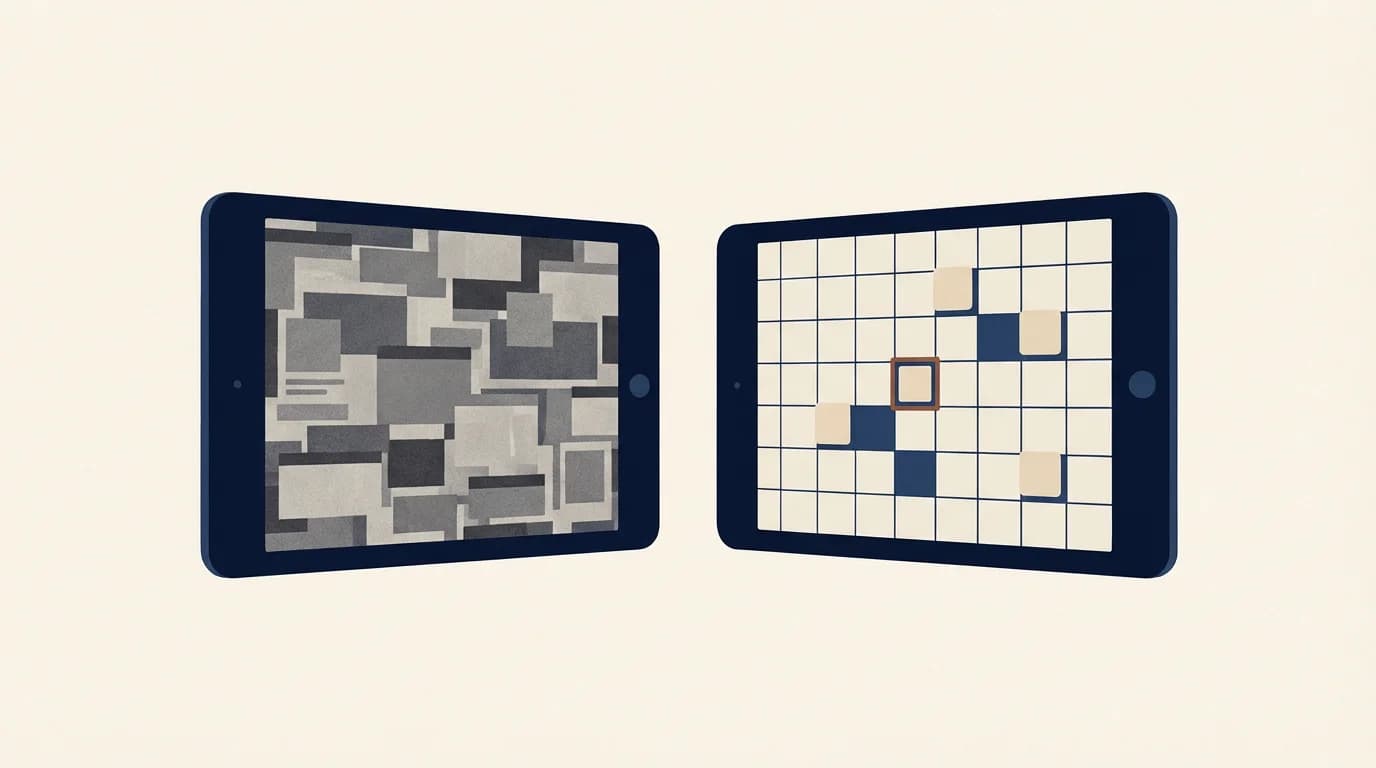
Why players are looking for an alternative
Scrabble GO launched in March 2020 under Scopely, replacing EA’s long-running Scrabble app. The reception was rough: TechRadar led its coverage with players calling it "tacky" and "ads-heavy", and a Change.org petition to preserve the old EA version crossed 1,400 signatures before EA pulled the plug on June 5, 2020.
Five years on, the structural complaints have not gone away. Independent reviewer Josh Bernoff describes a loop where players "face constant ads between turns" and the ad-free tier runs roughly $4.99 a month. Hardcore Droid flagged a separate friction point — level-up interstitials that take "a good 10–15 seconds" before you can resume the match.
If you are here because you have quit, or are about to, this page is a direct comparison. No App Store screenshots, no logos, no ratings math. Just what WordSalvo does differently, with sources where a claim isn’t ours to make.
The ad model: never mid-game, first game always clean
WordSalvo runs two ad surfaces: a banner on the lobby and an interstitial between games, capped at roughly one per two-to-three games. There are no ads during a turn, between turns, or on a level-up — and a first-time player never sees an ad until they have finished at least one game. Premium removes them entirely.
That constraint is the opposite of what Bernoff documents in Scrabble GO, where the interstitial cadence is described as "after almost every play." The business reasoning is also opposite: the ad tier exists so players who do not want to pay can still play, not as pressure toward a subscription.
| WordSalvo | Scrabble GO | |
|---|---|---|
| Ads during gameplay | Never — banner lobby + between-games only | Reported between turns (Bernoff) |
| AI opponents | Always labelled as AI (easy / medium / hard / expert) | Unlabelled bots reported (Bernoff) |
| Pay-to-win | No — Premium is analysis, cosmetics, and convenience | Not pay-to-win, but heavy gem / monetisation surface |
| Post-game engine analysis | Yes — brilliancy score, optimal moves, turning points | Not shipped |
| Languages | English and Dutch at go-live | 1 (English) |
| Pricing model | Free + one-time Ad-Free + optional Word Master | Free + ~$4.99/mo ad-free subscription |
No unlabelled bots. AI opponents are clearly AI.
The sharpest complaint about Scrabble GO is the bot question. Bernoff identifies opponents recognisable "by the blue clouds around their avatars, and their ‘best word’ score is zero," and WordFinder describes the same pattern: accounts with no word-score history and oddly regular turn timing. Whatever the intent, players end up unsure whether the opponent they just lost to was human.
WordSalvo does not fill its lobbies with bots wearing human names. AI opponents exist — four difficulty levels, run on a Cloud Function — and every single one is tagged "AI" in the lobby card, the game header, and the post-game screen. Matchmaking against humans uses a ±200 rating-point window through a Firestore queue and never drops you into a board; a match surfaces as a lobby card you choose to accept.
Fair play is server-side, not vibes
Every move in an online WordSalvo game is submitted through a Firestore transaction and re-scored on the server. A fair-play pipeline combines per-move analysis with per-player baseline checks and flags suspicious patterns — cases where a player "just happened" to find the engine’s best move too often. Report, block, and mute live in the same UI; chat runs a toxicity filter.
This matters for switchers because the Scrabble GO criticisms are not limited to ads. Bernoff’s piece covers chat harassment and scammer behaviour in the same breath as bots, and fixing that requires actual server-side enforcement, not cosmetic mute buttons. Our fair-play write-up walks through what the pipeline flags and how reports are handled.
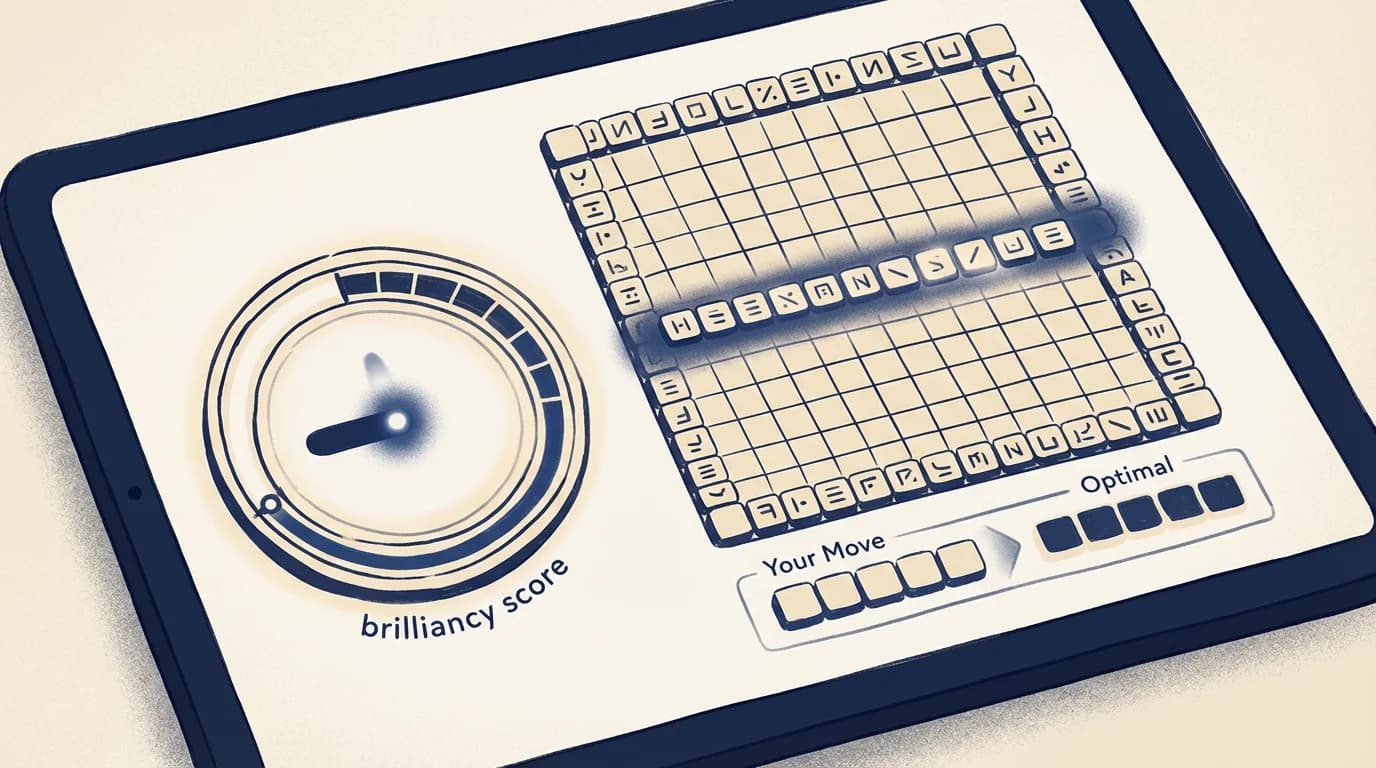
Post-game analysis: the thing the incumbents do not ship
The moment a game ends, WordSalvo runs client-side instant stats in under a millisecond — decisive moment, rack penalty, personal records — and then a server-side engine pass. The server replays every move, scores it against the best available play, and returns three things: a Brilliancy Score (the share of optimal points you captured), a list of optimal moves you missed, and turning points where the game actually tilted.
Neither Scrabble GO nor Wordfeud ships an equivalent. You can cobble one together with external word-finder sites, but that is effectively cheating during the game, not reflection after it. In WordSalvo, rated online games can receive analysis — free players get instant stats, and the Word Master plan unlocks the full engine pass.
What you keep, what you lose in the switch
You keep the core: 15×15 board, seven-tile rack, premium squares, bingo bonus, swap, pass, rated play. The rules are close enough that muscle memory transfers within a game or two. WordSalvo’s bingo pays +45 points instead of Scrabble’s 50 or Wordfeud’s 40 — enough to reward a rack-clear without letting one play decide the match.
You lose a few things. Your Scrabble GO account, stats, and friends list do not transfer — Scopely does not publish an export API, and we will not pretend otherwise. Rebuilding a friend graph takes a minute: WordSalvo friends use a 6-character code shareable over WhatsApp, Messenger, SMS, or QR. You also move from English-only to English and Dutch go-live dictionaries with their own native letter distributions.
Frequently asked questions
- is scrabble go owned by hasbro?
- Hasbro owns the Scrabble brand; Scopely develops and operates Scrabble GO under licence. It launched in March 2020 and replaced EA’s Scrabble app, which was discontinued on June 5, 2020. That ownership split is part of why the app shifted from a one-time-purchase model to the current free-with-ads-and-gems structure.
- can I import my scrabble go games or stats?
- No. Scopely does not publish a public export API for Scrabble GO, so no third-party app can legitimately migrate your game history, win streak, or friends list. You start fresh in WordSalvo. The upside: WordSalvo’s rating system is Glicko-2, which converges quickly — after about ten rated games your tier settles near your real level.
- does scrabble go have post-game analysis?
- Not in any comparable form. Scrabble GO ships score summaries and a move log, not an engine review. Covered WordSalvo rated games can run an engine pass: a Brilliancy Score for the share of optimal points you captured, a list of best moves you missed, and the turning points where the match actually tilted.
- is wordsalvo really free, or is there a catch?
- Core play is free, and nothing that changes whether you win is behind a paywall. Ads are banner-only in the lobby plus an interstitial between games — never mid-game. Optional Ad-Free is a one-time purchase; Word Master adds engine analysis, unlimited daily-puzzle retries, and cosmetics.
- are there bots in wordsalvo multiplayer lobbies?
- No. AI opponents exist — four difficulty levels that run in a Cloud Function — and every single one is clearly tagged "AI" in the lobby, the game header, and the final screen. Matchmaking against humans uses a ±200 rating-point window and surfaces matches as a lobby card you choose to accept, never an auto-navigate into a board.
- which platforms does wordsalvo run on?
- WordSalvo runs on iOS and Android. Flutter means both platforms share one codebase, so features ship together rather than lagging by months.