Language support built for real play
What "supported" means when every language has its own bag, its own dictionary, and its own definition source.
Last updated April 17, 2026 · By Kurt Bijl
The go-live dictionaries
Each go-live language has its own bag of tiles, its own letter-point values, its own dictionary, and its own definition file. You are not playing the English game with a translated menu. A Dutch match uses Dutch letter values and Dutch-language definitions.
The table below follows the go-live claim: English and Dutch. More dictionary configs may exist internally, but they are not public copy until they are ready for release.
| Language | Wordlist | Definition coverage | Primary source |
|---|---|---|---|
| English | 279,079 | 100.0% | SOWPODS-derived + Kaikki enwiktionary |
| Dutch | 300,356 | 100.0% | OpenTaal (CC BY 3.0) |
What 'supported' means
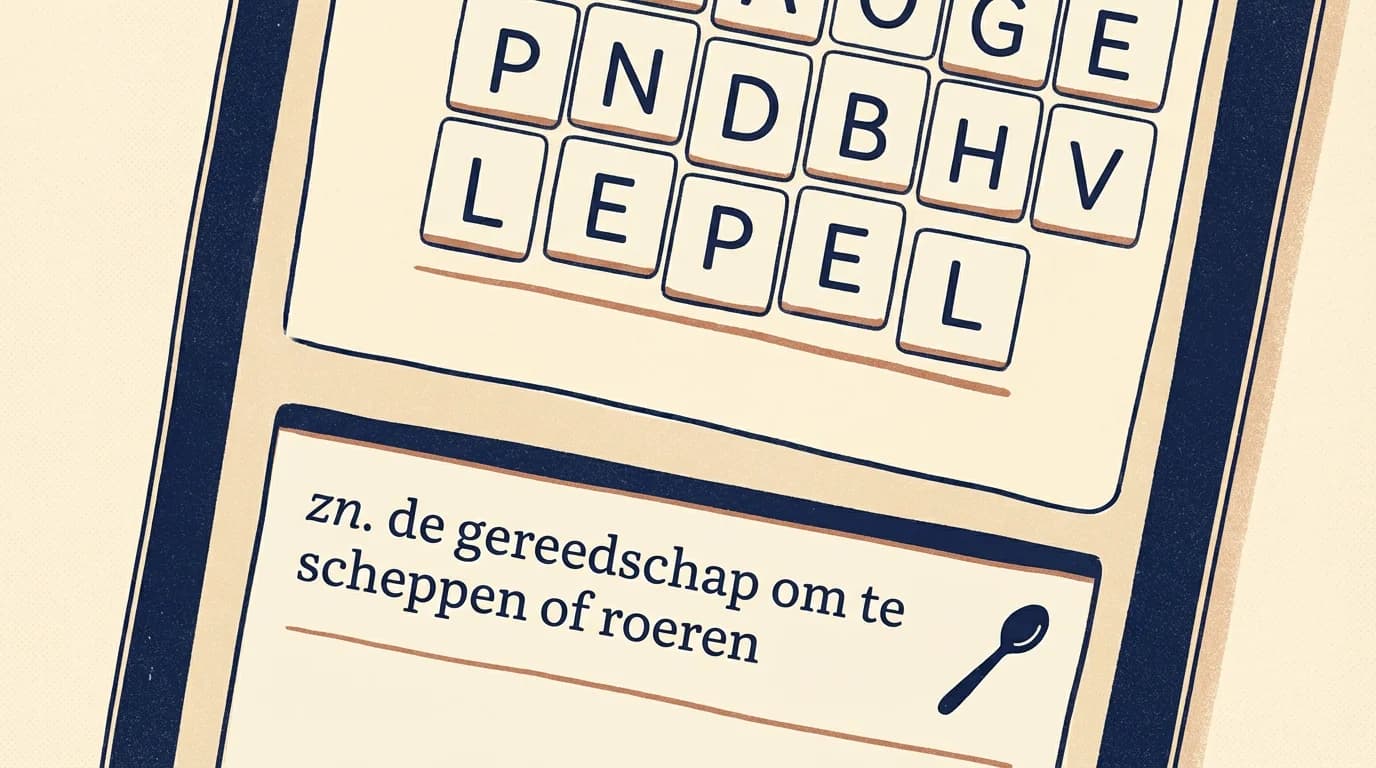
Three things, all native. First, the bag. Each language has a letter distribution tuned to that language; Dutch is not forced into the English tile bag. Second, the dictionary. Word validity is decided by a per-language DAWG (directed acyclic word graph) loaded at startup. Third, the definitions. Tap any played word and you get a gloss in that word's own language, not an English translation.
The DAWG that validates your move on your phone is byte-identical to the DAWG the server uses to re-validate it when you play online — no round-trip to a dictionary API, no flaky network call deciding whether your word counts.
Dictionary sources
Every dictionary cites back to something. Dutch is built on OpenTaal, the volunteer project that maintains the canonical open Dutch wordlist under CC BY 3.0. English leans on SOWPODS-lineage wordlists and Wiktionary-derived definitions.
We do not claim an official partnership with any of those sources; the wordlists are community-derived references. Player reports go through a review queue before they reach a dictionary rebuild.
Daily puzzle coverage
The Daily Puzzle launches in the same go-live languages: English and Dutch.
Additional dictionary configs can come later when they are exposed in public pickers and have enough active players for a good daily puzzle experience.
Adding new languages
Adding another public language is four things: a `LanguageConfig` describing the letter distribution and point values, a raw wordlist text file, a compiled DAWG for validation, and a definitions database for lookup. The rebuild is automated, and every wordlist change is checksummed against a frozen approved snapshot so a corrupt build cannot ship.
The hard part is not the pipeline. It is finding a source that is legally clean, morphologically honest, and plays well as a word game. If you want another language considered, the best signal is a public, permissively-licensed wordlist paired with a morphological database — UniMorph, a national federation list, or a Wiktionary export with inflection data. Write to us.
Frequently asked questions
- can i play in multiple languages at once?
- Yes. Language is chosen per game, not per account. Your rating and stats are tracked separately for each language, so an English rating and a Dutch rating can coexist. You can also have an English game and a Dutch game running at the same time against different opponents.
- is the dutch dictionary the same as wordfeud?
- No. WordSalvo uses the OpenTaal wordlist (CC BY 3.0) — 300,356 Dutch entries with 100% definition coverage. Wordfeud publishes its own proprietary Dutch list and does not document its source. The two will overlap heavily on common Dutch vocabulary but diverge on inflected forms, compounds, and dialect entries.
- are the definitions actually in my language or machine-translated english?
- Native. Definitions are sourced from native Wiktionaries and language-specific references, not machine-translated from English.
- how often do you update dictionaries?
- Every release can ship a new DAWG. Source wordlists are versioned and checksummed in a frozen approved snapshot, so updates are deliberate, not drifting. Player-reported missing or invalid words go through a review queue and land in the next rebuild.
- does tapping a word work offline?
- Dutch definitions are designed for local lookup after the dictionary data is available on device. English can use live definition lookup depending on the build and source license.